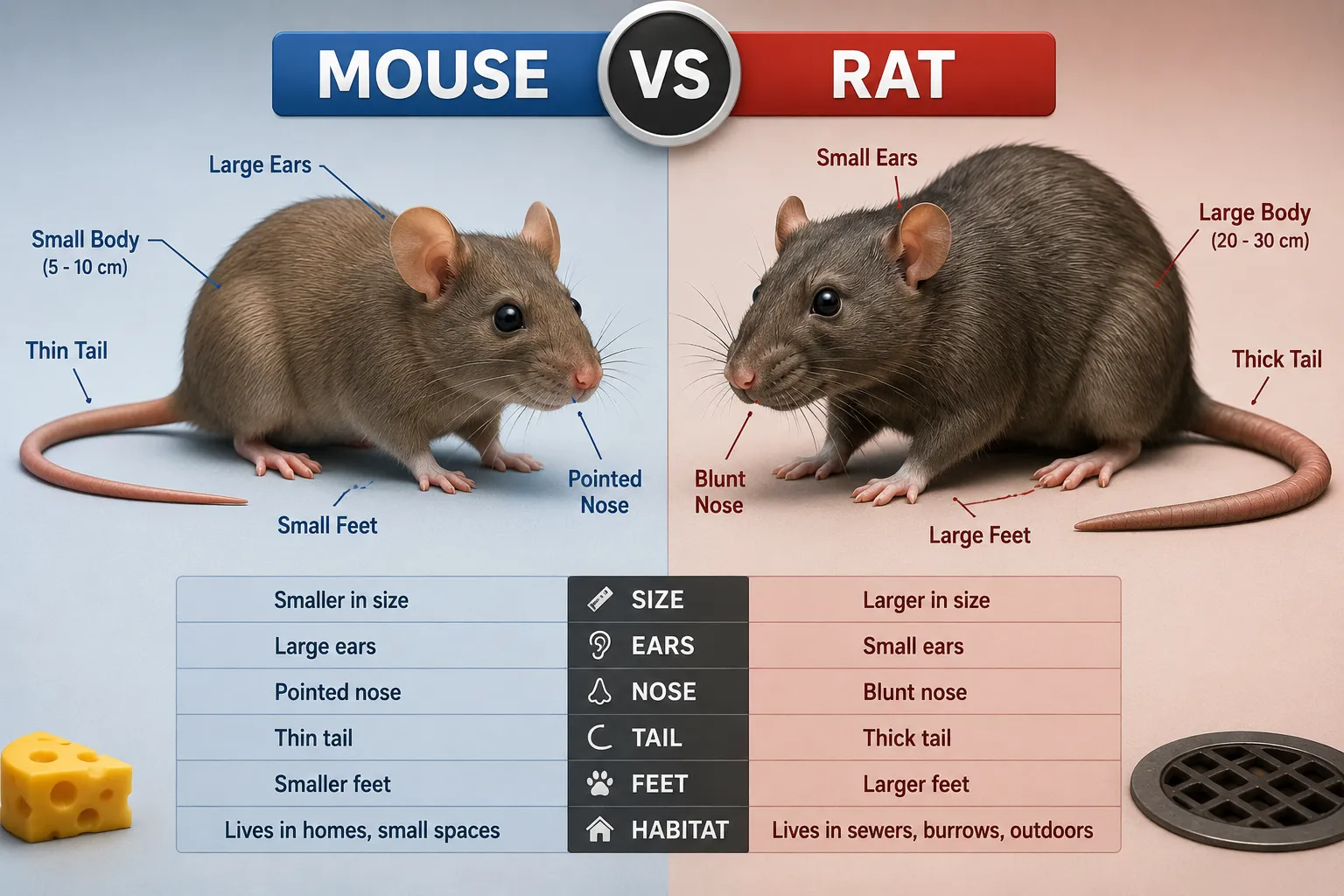
A mouse is a small rodent with a slender body, large ears, and a thin tail, while a rat is larger, heavier, and has a thicker body and tail. Although they belong to the same rodent family, they are different species with distinct appearances, behaviors, and habitats.
The first time I found tiny droppings in my garage, I immediately assumed I had a rat problem. After taking a closer look, I realized they belonged to a mouse instead. That experience taught me an important lesson: many people use these two words interchangeably, but they describe different animals. Knowing which one you’re dealing with can help you choose the right solution and avoid unnecessary worry.
If you’ve ever searched for mouse or rat, you’re probably trying to identify a rodent you’ve seen, understand the differences, or learn which one is more likely to enter your home. The confusion is understandable because both belong to the Muridae family and often live near humans.
This guide explains the differences between mice and rats in simple language. You’ll learn how to identify each animal, compare their behavior, understand where they live, avoid common mistakes, and discover practical tips backed by reliable sources such as Encyclopaedia Britannica, National Geographic, and Merriam-Webster.
Mouse or Rat Quick Answer
A mouse is generally much smaller than a rat. Mice have large ears, pointed noses, and thin tails, while rats have broader heads, thicker tails, and larger bodies.
Examples
- A house mouse squeezed through a tiny hole under the door.
- A Norway rat was spotted near the garbage bins.
The Origin and Background of Mouse and Rat
The words mouse and rat have been part of English for centuries.
According to Merriam-Webster, mouse comes from the Old English word mūs, which traces back to the Proto-Indo-European root mus, meaning a small rodent. Similar words appear in German (Maus), Dutch (muis), and many other European languages.
The word rat comes from the Middle English word ratte. Linguists believe it developed from early Germanic languages, although its exact origin is less certain than that of mouse.
From a biological perspective, both animals belong to the Rodentia order and the Muridae family. However, they are different genera. Common house mice belong to the genus Mus, while common rats belong to Rattus.
Understanding this distinction explains why they may look similar but differ in size, behavior, lifespan, and habitat.
Mouse or Rat Explained: Key Differences
Although mice and rats share some characteristics, several features make them easy to tell apart.
| Term | Meaning | When to Use | Context |
| Mouse | Small rodent in the genus Mus | Small household rodents | Homes, farms, laboratories |
| Rat | Larger rodent in the genus Rattus | Larger rodents | Cities, farms, sewers, warehouses |
Physical Differences
| Feature | Mouse | Rat |
| Size | 2.5–4 inches (body) | 7–10 inches (body) |
| Weight | 15–30 grams | 200–500 grams (or more) |
| Ears | Large | Smaller relative to head |
| Nose | Pointed | Blunt |
| Tail | Thin and long | Thicker and heavier |
| Body | Slim | Stocky |
Examples
Mouse
- A mouse ran behind the refrigerator.
- The child watched a tiny field mouse in the garden.
Rat
- The warehouse hired pest control after workers found a rat.
- A brown rat searched for food near the riverbank.
Which One Should You Identify?
For homeowners
A mouse usually leaves tiny droppings and can squeeze through openings as small as a pencil’s width.
For businesses
A rat infestation often requires immediate professional pest control because rats cause more structural damage.
For students
Remember this simple rule:
- Small body = Mouse
- Large body = Rat
For wildlife enthusiasts
Observe the ears, nose, and tail rather than relying only on size, especially if the animal is young.
Mouse vs. Rat Behavior
Mouse Behavior
- Curious and exploratory
- Eats small amounts frequently
- Climbs well
- Usually stays close to its nest
Rat Behavior
- More cautious around new objects
- Eats larger meals
- Excellent swimmer
- Travels farther for food
According to National Geographic, rats are generally more intelligent and cautious than mice, making them harder to trap.
Common Mistakes with Mouse or Rat
| Mistake | Correct |
| Every small rodent is a rat. | Many are actually mice. |
| Baby rats are mice. | Baby rats are still rats. |
| Mice and rats are the same species. | They are different species. |
| Rats always live in sewers. | Rats also live in farms, buildings, and parks. |
| Mice only live indoors. | Many species live outdoors. |
Why These Mistakes Happen
- Young rats resemble adult mice.
- Poor lighting makes identification difficult.
- Popular movies often blur the differences.
Mouse or Rat in Real-World Examples
Professional Email
We discovered signs of a mouse near the storage room and scheduled an inspection.
News Headline
City launches new program to reduce rat populations in public parks.
Social Media Post
Finally figured out it wasn’t a rat—it was just a tiny mouse hiding behind the shed!
Inspection Report
Evidence suggests activity from Norway rats near the building’s waste disposal area.
Mouse or Rat Data, Trends & Usage
Approximate Monthly Search Volume
Based on Semrush, Ahrefs, and general keyword trends (2025–2026):
| Keyword | Approximate Monthly Searches |
| mouse | 500,000+* |
| rat | 450,000+* |
| mouse vs rat | 20,000+ |
| mouse or rat | 5,000–10,000 |
*These broad keywords include multiple search intents, such as computer mice and the zodiac sign “Rat.”
Google Trends
Google Trends shows steady interest in mouse vs rat searches throughout the year, with occasional spikes during colder months when rodents are more likely to enter homes.
Scientific Usage
According to Encyclopaedia Britannica, the house mouse (Mus musculus) and the brown rat (Rattus norvegicus) are among the most widespread rodents in the world.
Search Intent
- Primary Intent: Informational
- Secondary Intent: Pest identification
- Related Intent: Home maintenance and wildlife education
Why This Topic Matters
As cities expand and more people live in urban environments, identifying rodents correctly helps homeowners choose appropriate prevention and pest-control methods.
Comparison Table
| Animal | Scientific Genus | Size | Common Habitat | Best Identified By |
| Mouse | Mus | Small | Homes, fields | Large ears, pointed nose |
| Rat | Rattus | Large | Cities, farms, warehouses | Thick tail, broad body |
| Vole | Microtus | Small | Grasslands | Short tail, rounded face |
| Shrew | Sorex | Very small | Gardens | Long pointed snout (not a rodent) |
Frequently Asked Questions
Q: What is the main difference between a mouse and a rat?
A: The biggest difference is size. Mice are much smaller and have larger ears relative to their heads, while rats are larger with thicker bodies and tails.
Q: Is a mouse a baby rat?
A: No. A mouse is a completely different species. Even a young rat will eventually grow much larger than an adult mouse.
Q: Which is more dangerous, a mouse or a rat?
A: Both can spread disease and contaminate food. However, rats generally cause more property damage because of their larger size and stronger teeth.
Q: How can I tell if I have mice or rats?
A: Look at the droppings, footprints, and entry holes. Mice leave smaller droppings and fit through much smaller openings than rats.
Q: Are mice and rats related?
A: Yes. Both belong to the Muridae family, but they belong to different genera: Mus for mice and Rattus for rats.
Q: Which animal is smarter?
A: Studies and wildlife experts generally consider rats to be more adaptable and better problem-solvers than mice.
Q: Can mice and rats live together?
A: It is uncommon. Rats often compete with or prey on mice, so they rarely share the same nesting area for long.
Conclusion
Although mice and rats belong to the same rodent family, they are not the same animal. Mice are smaller, lighter, and more delicate in appearance, while rats are larger, stronger, and generally more cautious. Paying attention to features such as body size, ears, nose, tail, and behavior can help you identify them correctly.
For homeowners, recognizing the difference is more than a matter of vocabulary—it can influence the best way to protect your property and respond to a rodent problem. For students and English learners, understanding these terms improves both your language skills and your general knowledge.
The next time you spot a rodent or come across the words mouse and rat, you’ll know exactly what sets them apart. Bookmark this guide for future reference, and share it with someone who has ever wondered whether they saw a mouse or a rat.
Read More:
Landline or Cell: The Complete Guide to Choosing the Right Phone

I specialize in English grammar, spelling, word choice, and language usage. My content is based on research from grammar references, style guides, dictionaries, and real-world usage to ensure it is accurate and practical.
At Spelling Comparison, I write guides that explain why words are confused, how they are used, and which form is correct in context. I also include proofreading tips, examples, and writing advice readers can apply immediately.
My goal is to publish clear, reliable content that helps readers make better writing decisions. Each guide is written for accuracy, clarity, and usefulness in school, work, business, and everyday communication.