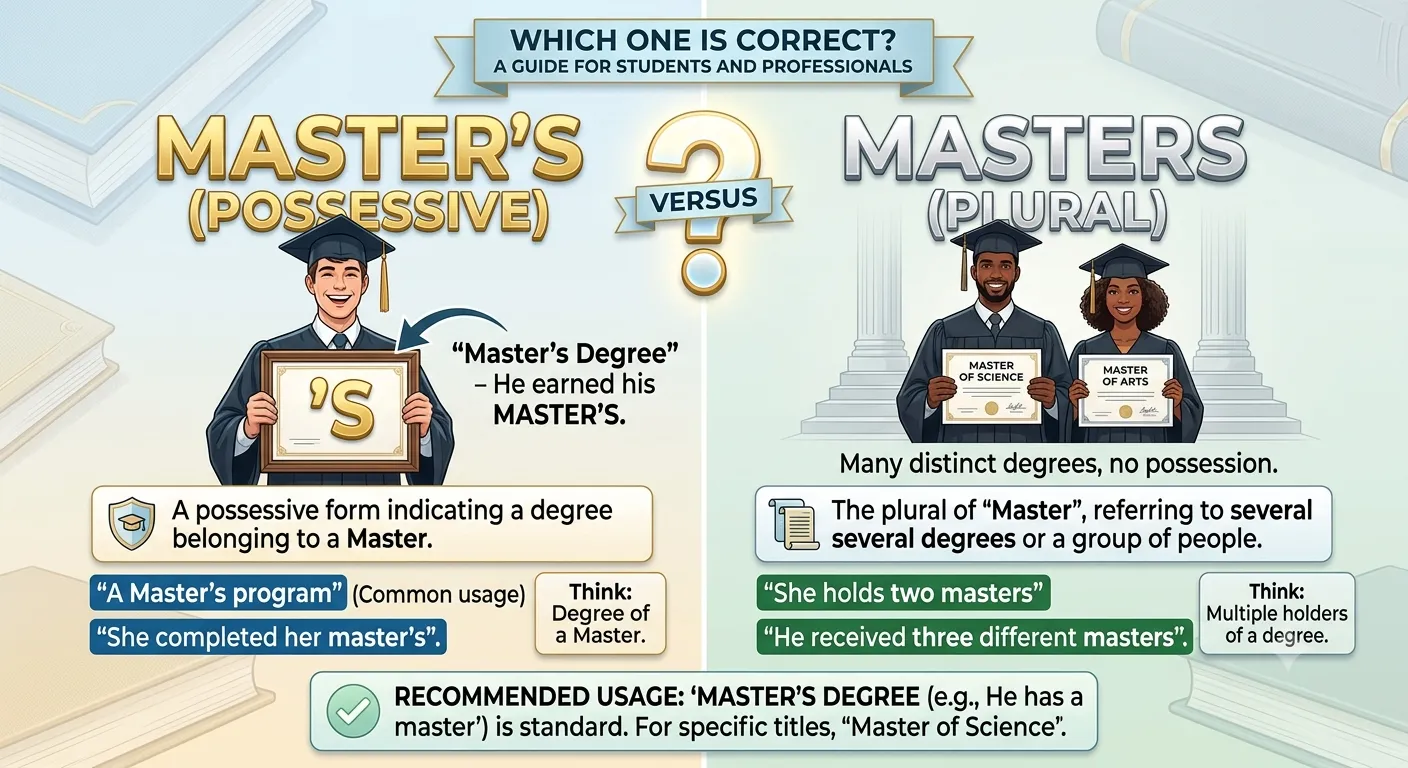
Master’s (with an apostrophe) is usually correct when referring to a master’s degree. Masters (without an apostrophe) is generally the plural of master, though it appears in some official program names and brand styles.
When I first started editing resumes, one mistake appeared again and again. People would proudly write, “I have a Masters in Business Administration.” It looked fine at first glance, but in most cases, it needed an apostrophe: master’s.
This small punctuation mark causes a lot of confusion. You’ll see universities, job ads, and even news articles using both masters and master’s. That naturally makes people wonder which version is actually correct.
The answer is simpler than it seems. In most everyday and professional writing, master’s is the correct form when talking about a graduate degree. However, there are a few important exceptions.
In this guide, you’ll learn the difference between masters and master’s, when to use each one, common mistakes to avoid, and real-world examples that make the rule easy to remember.
Masters or Master’s Quick Answer
Use master’s when referring to a master’s degree or a specific graduate qualification.
Use masters when talking about more than one master or when a university officially names a program without an apostrophe.
Simple examples
- She earned a master’s degree in biology.
- The chess masters competed in the final round.
The Origin and Background of Masters or Master’s
The phrase master’s degree comes from the idea that the degree belongs to a master. That is why the word takes a possessive apostrophe.
Read More:
Aid or Aide: The Complete Guide to the Difference
Over time, people began shortening master’s degree to simply master’s.
Example:
- I completed my master’s last year.
Many universities also use Masters in official program titles for branding purposes, such as Masters of Business Administration or Masters in Education. These official names do not change the general grammar rule.
Masters or Master’s Explained Key Differences
The difference depends on meaning.
| Term | Meaning | When to Use | Region/Context |
| Master’s | Possessive form referring to a graduate degree | Academic and professional writing | Worldwide |
| Masters | Plural of master or part of some official program names | General English and official titles | Worldwide |
Examples of Master’s
- She completed her master’s degree in engineering.
- I’m applying for a master’s in psychology.
- A master’s degree can improve your career opportunities.
Examples of Masters
- The golf tournament welcomed several former masters of the sport.
- The museum displayed works created by Renaissance masters.
- He compared several universities offering Masters in Data Science (official program title).
Which Version Should You Use?
Your audience matters.
For students
Use master’s degree or simply master’s in essays, applications, and resumes.
For job seekers
Write:
- Master’s Degree in Computer Science
Avoid writing Masters Degree unless you’re copying an employer’s exact wording.
For universities
Follow the institution’s official program title.
For example:
- Master’s degree in History
- Masters of Public Health (if this is the university’s official title)
For general writing
The safest and most widely accepted choice is master’s when referring to the degree itself.
Common Mistakes with Masters or Master’s
| Mistake | Correct Version | Why It Happens |
| Masters degree | Master’s degree | The degree name is possessive. |
| I earned my masters. | I earned my master’s. | The shortened form keeps the apostrophe. |
| Master’s students are masters students. | Master’s students | Refers to students pursuing a master’s degree. |
| I have a Masters in Biology. | I have a master’s in Biology. | General writing follows standard grammar. |
| Removing the apostrophe everywhere | Keep it unless using an official title | Branding differs from grammar rules. |
Masters or Master’s in Real-World Examples
Professional Email
“I recently completed my master’s degree in public health and would like to apply for the position.”
News Headline
“University Announces New Master’s Program in Artificial Intelligence”
Social Media Post
“Finally finished my master’s! Years of hard work paid off.”
Formal Report
“Applicants must hold a master’s degree from an accredited institution.”
Masters or Master’s Data, Trends & Usage
Many people search for masters or master’s because they see both forms on university websites and job listings.
Most common search intent
- Informational
- Grammar guidance
- Resume writing
- Academic writing
- Degree formatting
Regions with high interest
- United States
- United Kingdom
- Canada
- Australia
- India
Why this topic matters now
More people are pursuing graduate education than ever before. Using the correct degree name on resumes, applications, and professional profiles creates a polished first impression.
Comparison Table
| Term/Variant | Meaning | Region/Context | Best Used When |
| Master’s | Graduate degree | Standard English | Essays, resumes, emails, reports |
| Master’s degree | Full degree name | Academic writing | Formal documents |
| Masters | Plural of master | General English | Referring to multiple experts |
| Masters | Official program title | University branding | Copying an institution’s official name |
Frequently Asked Questions
Q: What does master’s mean?
A: Master’s is the possessive form used in master’s degree, a graduate-level academic qualification.
Q: What does masters mean?
A: Masters is the plural of master. It can also appear in some official university program names.
Q: Masters vs master’s — what’s the difference?
A: Master’s refers to the academic degree, while masters usually refers to multiple masters or an official title chosen by an institution.
Q: Is master’s correct in formal writing?
A: Yes. Master’s degree is the standard form used in academic, professional, and business writing.
Q: Which version is correct — masters or master’s?
A: In most situations involving a graduate degree, master’s is correct. Use masters only when referring to multiple masters or when following an official program name.
Q: Why does master’s have an apostrophe?
A: The apostrophe shows possession. Originally, it meant a degree of a master, and the possessive form has remained standard.
Q: Can I write “I have a master’s”?
A: Yes. This is a common and correct shortened form of master’s degree.
Conclusion
Knowing when to use masters or master’s is mostly about remembering one simple rule. If you’re talking about a graduate degree, master’s is almost always the correct choice. The apostrophe is part of the standard name and should not be omitted in normal writing.
Keep these tips in mind:
- Use master’s degree in resumes, essays, and professional documents.
- Use master’s as the shortened form.
- Use masters only for the plural of master or an institution’s official program title.
- When in doubt, choose master’s for academic qualifications.
With this rule, you’ll write with greater confidence and avoid one of the most common grammar mistakes. Bookmark this guide so you never second-guess “masters” or “master’s” again, and share it with anyone applying for graduate school or updating a resume.

I’m **James Whitmore**, a professional editor and English language content writer with more than 10 years of experience creating educational content. I specialize in spelling comparisons, grammar, vocabulary, synonyms, commonly confused words, proofreading, and English usage. My goal is to help readers write with confidence by providing clear, accurate, and well-researched articles that make complex language topics easy to understand.