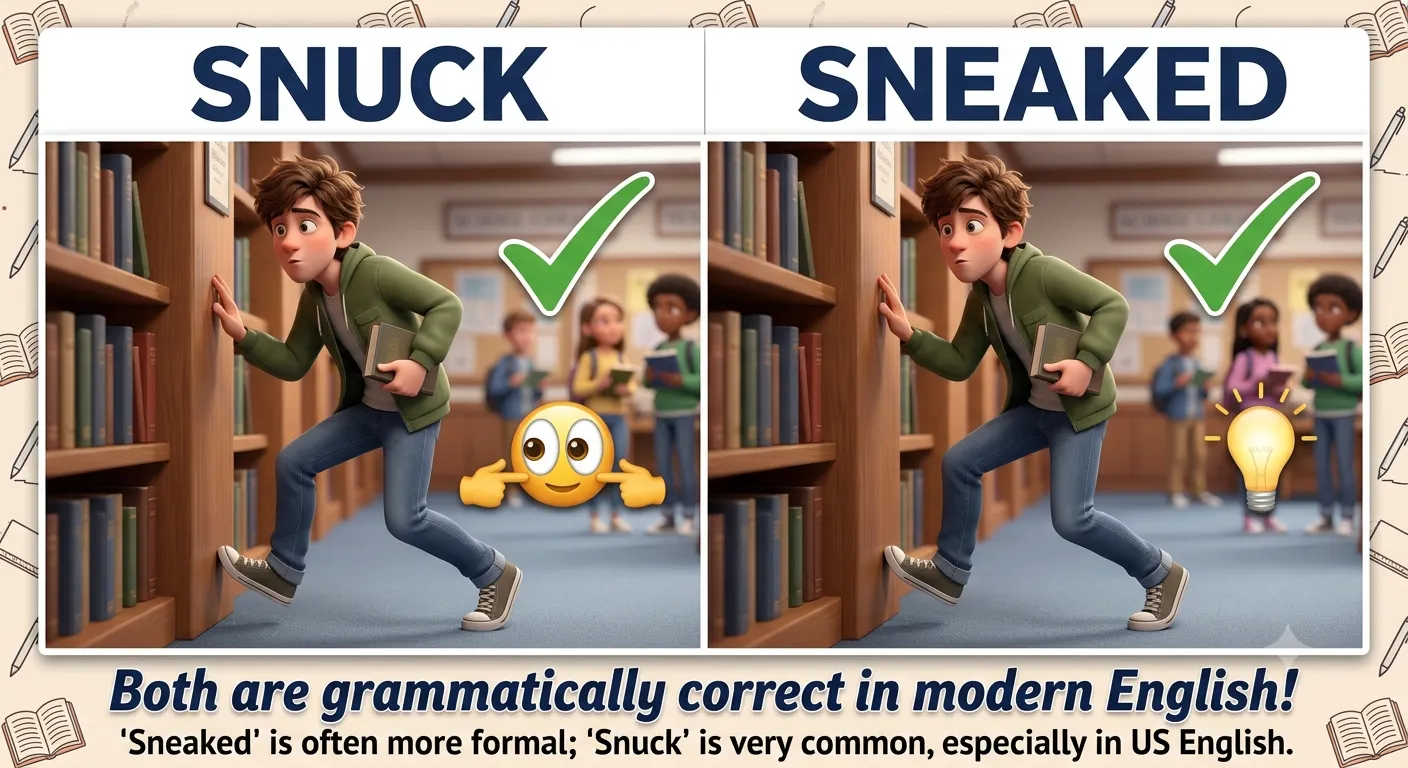
Snuck and sneaked are both correct past tense forms of sneak. Snuck is more common in American English, while sneaked is often preferred in formal writing and is more common in British English.
I once edited an article where the writer used snuck in one paragraph and sneaked in the next. Neither word was wrong, but the mix made the writing feel inconsistent. It reminded me how often these two forms confuse even experienced writers.
If you’ve ever stopped before writing, “He snuck into the room” or “He sneaked into the room,” you’re in good company. Both forms appear in books, newspapers, and everyday conversations. The real question is which one should you choose?
The answer depends on your audience, your writing style, and sometimes where your readers live. In this guide, you’ll learn the difference between snuck and sneaked, their history, when each is best, common mistakes to avoid, and plenty of real-world examples.
Snuck or Sneaked Quick Answer
Both snuck and sneaked are correct past tense and past participle forms of sneak.
Simple examples
- She snuck into the movie without anyone noticing.
- He sneaked out of the house before sunrise.
Both sentences are grammatically correct.
The Origin and Background of Snuck or Sneaked
The original past tense of sneak was sneaked. It appeared in English centuries ago and remained the standard form for a long time.
The word snuck began appearing in North America during the late 1800s. It likely became popular because it sounded similar to other irregular verbs like stick → stuck and strike → struck.
At first, many grammar experts considered snuck incorrect. Over time, however, it became widely accepted. Today, major dictionaries recognize snuck as a standard English word.
Read More:
Aid or Aide: The Complete Guide to the Difference
Snuck or Sneaked Explained Key Differences
The meaning is exactly the same. The difference is mainly one of style, region, and formality.
| Term | Meaning | When to Use | Region/Context |
| Snuck | Past tense of sneak | Casual and everyday writing | More common in American English |
| Sneaked | Past tense of sneak | Formal writing and traditional usage | More common in British English |
Examples with Snuck
- The cat snuck into the garage.
- We snuck out after dinner.
- Someone snuck a surprise gift onto my desk.
Examples with Sneaked
- The children sneaked quietly upstairs.
- He sneaked a look at the answers.
- They sneaked away before the crowd arrived.
Which Version Should You Use?
Your choice depends on who will read your writing.
For students
Use sneaked if your teacher prefers traditional grammar or formal writing.
For everyday conversation
Snuck sounds natural to many American English speakers.
For professional writing
Sneaked is often the safer choice because it is slightly more formal.
For international readers
If you’re writing for a global audience, sneaked is usually the better option since it is widely accepted in both American and British English.
Common Mistakes with Snuck or Sneaked
| Mistake | Correct Version | Why It Happens |
| He sneak into the room. | He snuck into the room. | Past tense is needed. |
| She has sneak out. | She has snuck out. / She has sneaked out. | Past participle is required. |
| Snuck is always wrong. | Both forms are correct. | Outdated grammar advice. |
| Sneaked is incorrect. | Sneaked is fully correct. | Many people only hear “snuck.” |
| Mixing both forms in one article | Choose one style and stay consistent. | Consistency improves readability. |
Snuck or Sneaked in Real-World Examples
Professional Email
“An employee sneaked into the restricted area without authorization.”
News Headline
“Teen Snuck Into Stadium Before Championship Game”
Social Media Post
“I snuck one more cookie before dinner. Don’t tell anyone!”
Formal Report
“The suspect sneaked through the unsecured entrance during the evening shift.”
Snuck or Sneaked Data, Trends & Usage
Many English learners search for snuck or sneaked because both words appear in dictionaries and published writing.
Most common search intent
- Informational
- Grammar guidance
- Correct past tense
- Writing improvement
- English learning
Regions with high interest
- United States
- United Kingdom
- Canada
- Australia
- India
Why this topic matters now
English changes over time. Knowing when both forms are acceptable helps you write naturally while matching your audience’s expectations.
Comparison Table
| Term/Variant | Meaning | Region/Context | Best Used When |
| Snuck | Past tense of sneak | Mostly American English | Casual writing and conversation |
| Sneaked | Past tense of sneak | Worldwide, especially British English | Formal writing and academic work |
| Snuck | Informal but accepted | American publications | Everyday storytelling |
| Sneaked | Traditional form | Schools, reports, official documents | Professional communication |
Frequently Asked Questions
Q: What does snuck mean?
A: Snuck is the past tense and past participle of sneak. It means to move quietly or secretly and is especially common in American English.
Q: What does sneaked mean?
A: Sneaked has the same meaning as snuck. It is the original past tense form and is often preferred in formal or British English.
Q: Snuck vs sneaked what’s the difference?
A: There is no difference in meaning. The main difference is style and regional preference.
Q: Is snuck acceptable in formal writing?
A: Yes, many style guides and dictionaries accept it. However, sneaked is still the more traditional and slightly more formal choice.
Q: Which version is correct: snuck or sneaked?
A: Both are correct. Choose snuck for a more conversational American style and sneaked for a more formal or international audience.
Q: Where does snuck come from?
A: Snuck became popular in North America during the late nineteenth century. It developed by analogy with verbs like stick–stuck and strike–struck.
Q: Can snuck be used in academic writing?
A: Yes, but many teachers, editors, and institutions still prefer sneaked because it is the traditional form. Check your style guide if one applies.
Conclusion
Choosing between snuck or sneaked doesn’t have to be difficult. Both words are correct, and both mean exactly the same thing. The main difference is your audience and writing style.
Remember these simple tips:
- Snuck is more common in American English and casual writing.
- Sneaked is the traditional form and often preferred in formal or academic writing.
- Both are accepted by modern dictionaries.
- Stay consistent by using the same form throughout your piece.
Now that you know the difference, you can choose the version that best fits your readers and your writing style. Bookmark this guide so you never second-guess “snuck” or “sneaked” again, and share it with anyone learning English.

I am an English language specialist with over 10 years of experience writing about grammar, spelling differences, and language usage. Dedicated to helping writers communicate with confidence, my detailed guides break down complex rules into clear, real-world advice. At Spelling Comparison, my focus is on providing actionable proofreading tips and vocabulary deep-dives to ensure your writing is always accurate, clear, and impactful.