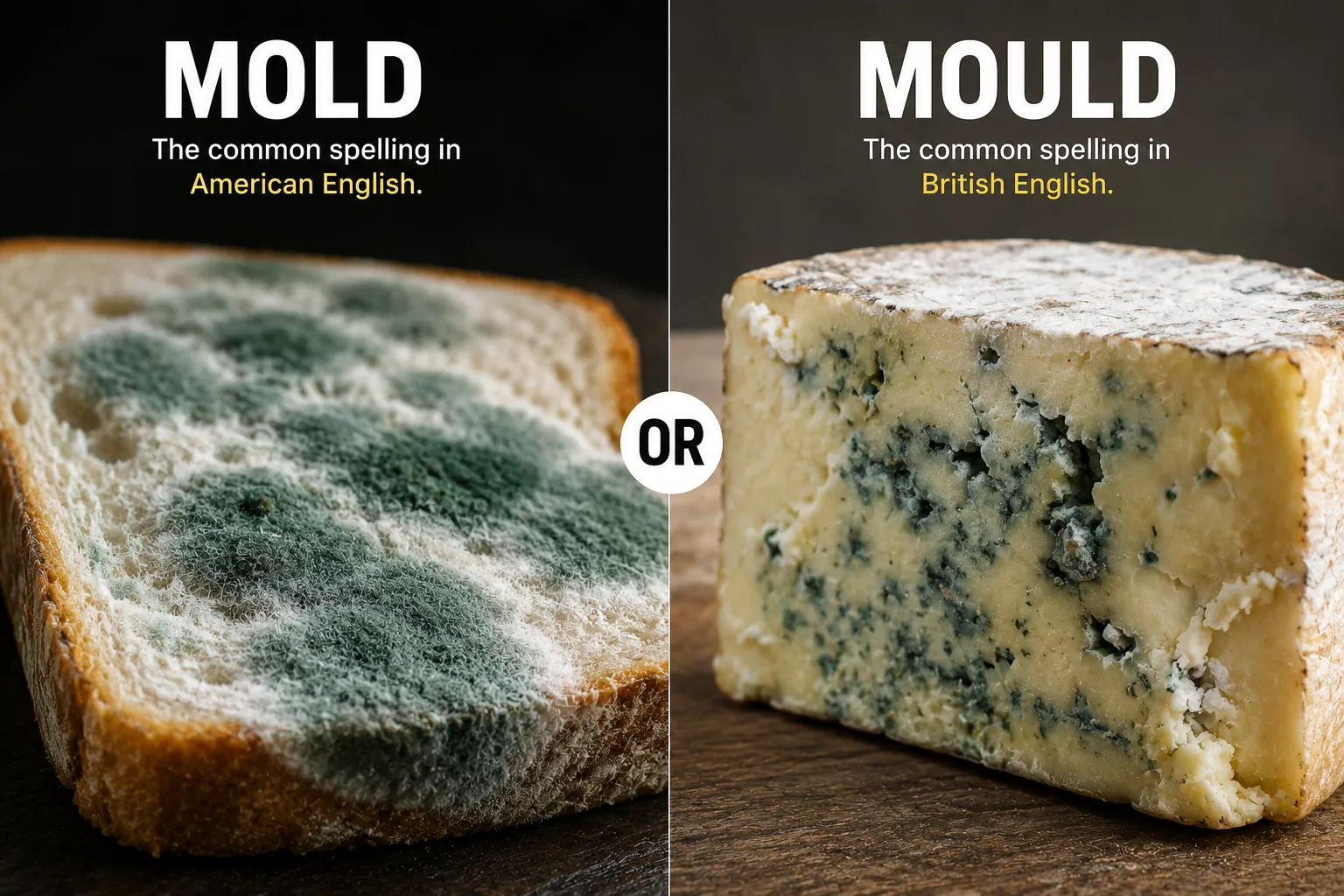
Mold and mould have the same meaning but different spellings. Mold is the preferred spelling in American English, while mould is the standard spelling in British English, Australian English, and most other Commonwealth countries. Use the spelling that matches your audience.
A while ago, I was editing an article about home maintenance when I noticed something odd. The title used “mold removal,” but halfway through the article it switched to “mould inspection.” Neither spelling was wrong, yet mixing them made the writing look inconsistent and less professional. That experience reminded me how important it is to match your spelling to your audience.
If you’ve searched for mold or mould, you’re probably wondering which spelling is correct. Maybe you’re writing a school assignment, a business report, a health article, or even a DIY guide. The good news is that you don’t have to memorize two different meanings because both words refer to the same thing.
In this guide, you’ll learn the difference between mold and mould, where each spelling is used, their history, common mistakes, real-world examples, and practical tips for choosing the right version with confidence.
Mold or Mould Quick Answer
Both mold and mould are correct spellings. The only real difference is regional English.
- Use mold in American English.
- Use mould in British English, Australian English, and most Commonwealth countries.
Examples
- The bread developed mold after a week.
- The old cottage had mould on the bathroom ceiling.
The Origin and Background of Mold and Mould
The words mold and mould share the same linguistic history.
According to Merriam-Webster, Oxford English Dictionary, and Etymonline, the word comes from Old English molde, meaning earth, soil, or dust. Over time, its meaning expanded to include a fungus, a shape or form, and a container used to shape materials.
As English evolved, spelling differences developed across regions.
- American English gradually simplified many spellings during the 19th century, influenced by lexicographer Noah Webster. One result was mold.
- British English kept the traditional spelling mould, which remains the standard in the UK and many Commonwealth countries.
Although the spellings differ, dictionaries agree that the meanings are identical.
Mold or Mould Explained: Key Differences
The difference is based on spelling, not meaning.
| Term | Meaning | When to Use | Region |
| Mold | Fungus or shaping form | American English | United States |
| Mould | Fungus or shaping form | British English | UK, Australia, New Zealand, many Commonwealth countries |
Examples
Mold
- The basement has mold on the walls.
- Pour the chocolate into the mold.
Mould
- The bathroom ceiling has mould.
- Fill the cake mould before baking.
Both sentences mean exactly the same thing. Only the spelling changes.
Different Meanings of Mold/Mould
Although the spelling changes by region, the word has several meanings.
1. Fungus
A growth that appears in damp places.
Example
- Clean the mold before it spreads.
2. Shaping Container
A hollow form used to shape materials.
Example
- The artist poured plaster into the mould.
3. To Shape Something (Verb)
To form or influence.
Example
- Great teachers mold young minds.
- Great teachers mould young minds. (British English)
Which Version Should You Use?
Choose the spelling based on your readers.
For American readers
Use mold.
For British readers
Use mould.
For Australian and New Zealand readers
Use mould.
For international businesses
Pick one spelling style and stay consistent throughout the document.
For students
Follow the spelling rules required by your school or style guide.
Common Mistakes with Mold or Mould
| Mistake | Correct |
| Mixing mold and mould in one article | Use one spelling consistently |
| Thinking they have different meanings | They mean the same thing |
| Using mould in American academic writing | Prefer mold |
| Assuming mold is incorrect | It is standard American English |
| Believing only fungus is called mold | The word also means a shaping form |
Why These Mistakes Happen
- American and British English use different spelling conventions.
- Writers often copy information from multiple sources.
- Spell-check software may automatically change the spelling based on language settings.
Mold or Mould in Real-World Examples
Professional Email
We found mold in the storage room and scheduled a professional inspection.
News Headline
Heavy rainfall increases mould growth in older homes across the region.
Social Media Post
Finally cleaned the mold behind my washing machine. It looks brand new!
Construction Report
Moisture levels may encourage mould growth if ventilation is not improved.
Manufacturing Guide
Allow the plastic to cool completely before removing it from the mold.
Mold or Mould – Data, Trends & Usage
Approximate Monthly Search Volume
Based on Semrush, Ahrefs, and general keyword data (2025–2026):
| Keyword | Approximate Monthly Searches |
| mold | 1,000,000+ |
| mould | 250,000+ |
| mold vs mould | 4,000–8,000 |
| mold or mould | 2,000–5,000 |
Google Trends
Google Trends consistently shows:
- Mold dominates searches in the United States.
- Mould receives higher search interest in the United Kingdom, Australia, Ireland, and New Zealand.
Corpus Data
According to Google Ngram Viewer, mould appears more often in British publications, while mold is significantly more common in American books and newspapers.
Search Intent
- Primary Intent: Informational
- Secondary Intent: Grammar and spelling
- Related Intent: Home maintenance and health
Why This Topic Matters
As businesses increasingly publish content for global audiences, choosing the correct regional spelling improves readability, professionalism, and SEO targeting.
Comparison Table
| Variant | Meaning | Region/Context | Best Used When |
| Mold | Fungus, shaping form, verb | American English | US websites, schools, businesses |
| Mould | Fungus, shaping form, verb | British English | UK, Australia, New Zealand |
| Molding | Decorative trim or shaping process | Mainly American English | Construction and interior design |
| Moulding | Decorative trim or shaping process | Mainly British English | Commonwealth English |
Frequently Asked Questions
Q: What does mold mean?
A: Mold refers to a fungus that grows in damp environments. It can also mean a hollow form used to shape materials such as chocolate, clay, or plastic. Merriam-Webster recognizes both meanings.
Q: Is mould the same as mold?
A: Yes. The meanings are identical. The difference is only the preferred spelling in different varieties of English.
Q: Which spelling is correct: mold or mould?
A: Both are correct. Use mold for American English and mould for British and most Commonwealth English.
Q: Can I use mold in formal writing?
A: Yes. Mold is the standard spelling in American academic, professional, and business writing.
Q: Why does British English use mould?
A: British English kept the traditional spelling, while American English adopted simplified spellings during the reforms promoted by Noah Webster.
Q: Does mold always refer to fungus?
A: No. It can also describe a container used for shaping objects or the act of forming or influencing something.
Q: Should I mix mold and mould in one article?
A: No. Choose the spelling that matches your target audience and use it consistently throughout your writing.
Conclusion
Understanding the difference between mold and mould is easier than many people expect. They share the same meanings and grammatical functions. The only distinction is regional spelling. Mold is the preferred choice in American English, while mould remains the standard in British English and most Commonwealth countries.
When writing, think about who will read your content. Matching your spelling to your audience makes your work look polished, professional, and trustworthy. It also helps maintain consistency across websites, reports, academic papers, and marketing materials.
Whether you’re discussing household fungus, baking equipment, manufacturing, or personal development, choosing the appropriate spelling is simple once you know your audience. Bookmark this guide so you never hesitate between “mold” and “mould” again, and share it with anyone learning English or writing for an international audience.
Read More:
Mouse vs. Rat: The Ultimate Comparison Guide

I’m **Rubab Naaz**, an English language content writer with over 10 years of experience creating educational and SEO-focused articles. I specialize in spelling comparisons, grammar, vocabulary, synonyms, commonly confused words, and English usage. My passion is helping students, writers, and professionals improve their language skills through accurate, well-researched, and easy-to-understand content. Every article I write is designed to make learning English simple, practical, and engaging.