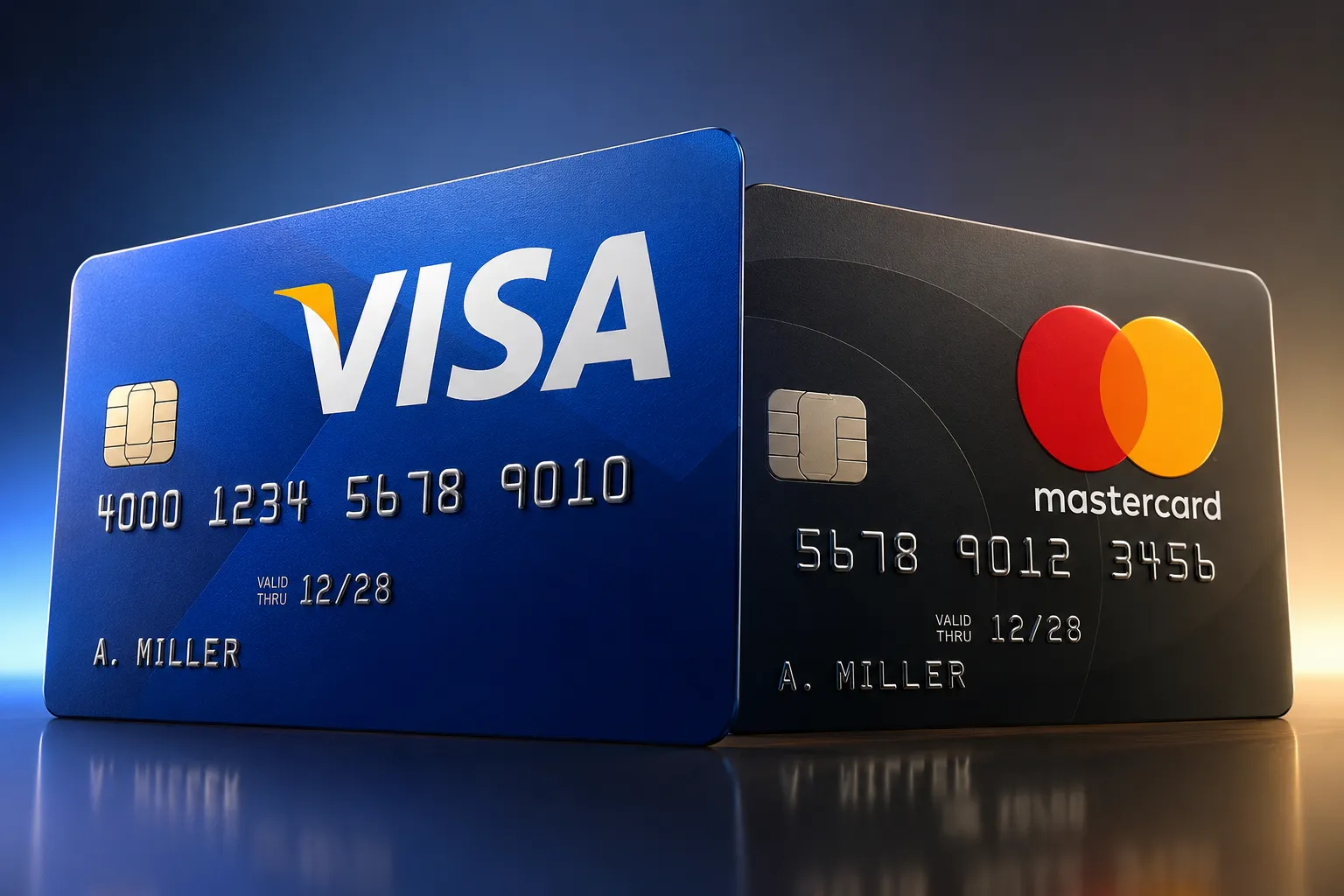
Visa and Mastercard are both global payment networks, not credit card issuers. Neither is universally “better” the right choice depends on your card’s rewards, fees, acceptance, and benefits rather than whether it carries the Visa or Mastercard logo.
A few years ago, I was helping a friend compare two credit cards before an overseas trip. One carried the Visa logo, while the other was a Mastercard. He immediately asked, “Which one is better?” Like many people, he assumed the payment network would determine which card offered more value.
After comparing both cards, we discovered something surprising. Their interest rates, rewards, travel insurance, and annual fees were completely different—even though one was Visa and the other was Mastercard. The biggest differences came from the bank that issued the card, not the payment network itself.
This is one of the most common misunderstandings about payment cards. Many shoppers believe Visa and Mastercard compete by offering different credit terms, but both companies mainly provide the payment network that connects merchants, banks, and customers.
If you’ve ever wondered whether you should choose Visa or Mastercard, this guide will explain the real differences, similarities, benefits, and how to pick the best option for your spending habits.
Visa or Mastercard Quick Answer
Visa and Mastercard are electronic payment networks that allow transactions between consumers, merchants, and financial institutions. They do not issue credit cards directly. Instead, banks and credit unions issue cards that use either network.
According to Visa and Mastercard, both companies operate in more than 200 countries and territories, offering extensive worldwide acceptance and secure payment technology.
Examples
- You receive a Visa credit card from your bank with cashback rewards.
- Another bank offers a Mastercard with travel insurance and airport lounge access.
In both cases, the issuing bank determines most of the card’s features.
The Origin and Background of Visa or Mastercard
The history of these payment networks dates back more than half a century.
Visa began in 1958 as the BankAmericard program launched by Bank of America. According to Visa’s official history, it adopted the name Visa in 1976 to support international expansion.
Mastercard originated in 1966 as the Interbank Card Association (ICA), a group of banks working together to compete with BankAmericard. It later became Master Charge before officially changing its name to Mastercard in 1979.
Over the years, both companies have expanded into digital payments, contactless technology, tokenization, fraud prevention, and mobile wallets such as Apple Pay, Google Pay, and Samsung Wallet.
Today, Visa and Mastercard process billions of transactions every year and are among the world’s largest payment technology companies.
Visa or Mastercard Explained Key Differences
Although they perform the same basic function, there are a few differences worth knowing.
| Feature | Visa | Mastercard |
| Primary Role | Payment network | Payment network |
| Global Acceptance | Excellent | Excellent |
| Countries & Territories | 200+ | 200+ |
| Contactless Payments | Yes | Yes |
| Mobile Wallet Support | Yes | Yes |
| Fraud Protection | Yes | Yes |
| Card Benefits | Determined mostly by issuing bank | Determined mostly by issuing bank |
Visa Example
Emily uses her Visa card to book flights and earn airline miles.
Mastercard Example
David pays for hotel stays using his Mastercard to receive travel-related benefits offered by his bank.
The experience depends far more on the card issuer than the payment network itself.
Which Should You Choose?
Your decision should focus on the card’s features rather than the logo.
For everyday shoppers
Compare cashback rates, annual fees, and introductory offers.
For travelers
Look for:
- No foreign transaction fees
- Travel insurance
- Rental car coverage
- Airport lounge access
These benefits depend largely on the issuing bank.
For students
Choose a card with:
- No annual fee
- Low interest rates
- Easy approval
- Credit-building tools
For business owners
Look for:
- Expense tracking
- Employee cards
- Purchase protection
- Business rewards
Best Overall Advice
If two cards offer similar fees and rewards, either Visa or Mastercard is an excellent choice. Focus on the issuer’s terms and benefits instead of assuming one payment network is always superior.
Visa or Mastercard Common Mistakes
Many people misunderstand how Visa and Mastercard work. Here are the most common mistakes and the correct information.
| Mistake | Correct Information | Why It Happens |
| Visa issues credit cards | Banks issue Visa cards | People confuse the payment network with the card issuer. |
| Mastercard sets interest rates | The issuing bank sets interest rates | Card terms vary by bank. |
| Visa is accepted everywhere, but Mastercard isn’t | Both are accepted at millions of merchants worldwide | Acceptance differences are now very small. |
| Visa always offers better rewards | Rewards depend on the card issuer | Banks design cashback, points, and travel benefits. |
| Mastercard is only for credit cards | Mastercard also supports debit, prepaid, and business cards | Many people only see Mastercard on credit cards. |
Tips to Remember
- Visa and Mastercard are payment networks.
- Banks issue the cards.
- Rewards and fees come from the bank, not the network.
- Compare the card—not just the logo.
Visa or Mastercard in Real-World Examples
Professional Email
Subject: Corporate Credit Card Selection
After reviewing both options, we recommend the Visa business card because it offers higher cashback on office supplies and lower annual fees than the available Mastercard option.
News Headline
Major Bank Launches New Mastercard with Enhanced Travel Rewards
Social Media Post
Just received my new Visa card! Looking forward to earning cashback on groceries and fuel.
Formal Report
The organization evaluated both Visa and Mastercard payment solutions before selecting a provider based on transaction costs, security features, and customer support.
Visa or Mastercard Data, Trends & Usage
Search Intent
Primary Search Intent: Commercial Investigation
Most users searching “Visa or Mastercard” want to compare:
- Which is better?
- Which has better rewards?
- Which is more widely accepted?
- Which card should they apply for?
Approximate Search Volume
Based on general patterns from Semrush, Ahrefs, and Google Trends (2025–2026 estimates):
| Keyword | Approximate Monthly Searches |
| Visa vs Mastercard | 90,000–150,000 |
| Visa or Mastercard | 20,000–40,000 |
| Visa card | 500,000+ |
| Mastercard | 500,000+ |
Figures are approximate and may vary over time.
Global Acceptance
According to the official Visa and Mastercard websites:
- Visa is accepted in 200+ countries and territories.
- Mastercard is also accepted in 200+ countries and territories.
For most consumers, the difference in merchant acceptance is minimal.
Google Trends Insights
Interest in Visa vs Mastercard remains steady throughout the year, with occasional spikes during:
- Holiday shopping seasons
- Major travel periods
- Credit card promotion campaigns
Countries showing high search interest include:
- United States
- Canada
- United Kingdom
- India
- Australia
Why This Topic Matters Today
Digital payments continue to replace cash worldwide. Contactless payments, mobile wallets, and online shopping have increased demand for secure payment networks. As consumers compare rewards cards, understanding the role of Visa and Mastercard helps them make smarter financial decisions.
Standalone Comparison Table
| Feature | Visa | Mastercard | Best Choice |
| Global Acceptance | Excellent | Excellent | Tie |
| Security Features | Advanced fraud monitoring | Advanced fraud monitoring | Tie |
| Contactless Payments | Yes | Yes | Tie |
| Digital Wallet Support | Apple Pay, Google Pay, Samsung Wallet | Apple Pay, Google Pay, Samsung Wallet | Tie |
| Card Benefits | Depends on issuer | Depends on issuer | Compare individual cards |
| Foreign Acceptance | Excellent | Excellent | Tie |
Key takeaway: In most situations, the issuing bank has a greater impact on your experience than the payment network.
Frequently Asked Questions
Q: What is the difference between Visa and Mastercard?
Visa and Mastercard perform the same core function: they process electronic payments. The main differences usually come from the bank issuing the card, including rewards, interest rates, and fees.
Q: Is Visa better than Mastercard?
Neither is universally better. Both offer worldwide acceptance, strong security, and reliable payment processing. The better choice depends on the specific card’s features.
Q: Are Visa and Mastercard accepted internationally?
Yes. Both networks operate in more than 200 countries and territories, making them excellent choices for international travel and online purchases.
Q: Which is better for travel?
Both are excellent for travel. Compare benefits such as travel insurance, foreign transaction fees, emergency card replacement, and airport lounge access offered by the issuing bank.
Q: Can I have both Visa and Mastercard?
Yes. Many consumers carry both. Having two different cards can provide additional flexibility, backup payment options, and access to different rewards programs.
Q: Does Visa or Mastercard offer better fraud protection?
Both invest heavily in fraud detection, encryption, tokenization, and secure payment technology. Your bank may also provide additional security features.
Q: Which is better for online shopping?
Both work exceptionally well for online purchases. Instead of focusing on the payment network, compare purchase protection, dispute resolution, and digital wallet compatibility offered by the card issuer.
Conclusion
Choosing between Visa and Mastercard is much easier once you understand how payment cards work. Both networks offer outstanding global acceptance, advanced security, and reliable payment processing. For most people, the real differences lie in the card issued by the bank—not the Visa or Mastercard logo on the front.
When comparing cards, pay close attention to annual fees, cashback or rewards, travel perks, interest rates, purchase protection, and customer service. These features have a much greater impact on your everyday experience than the payment network itself.
If two cards have similar benefits, you can confidently choose either Visa or Mastercard. Both are trusted by millions of merchants and consumers around the world.
Now you know exactly how to compare Visa and Mastercard. Before applying for your next card, compare the issuer’s benefits carefully, and bookmark this guide whenever you need a quick refresher.
Read More:
Yogurt or Yoghurt? Which Is Correct?

I specialize in English grammar, spelling, word choice, and language usage. My content is based on research from grammar references, style guides, dictionaries, and real-world usage to ensure it is accurate and practical.
At Spelling Comparison, I write guides that explain why words are confused, how they are used, and which form is correct in context. I also include proofreading tips, examples, and writing advice readers can apply immediately.
My goal is to publish clear, reliable content that helps readers make better writing decisions. Each guide is written for accuracy, clarity, and usefulness in school, work, business, and everyday communication.