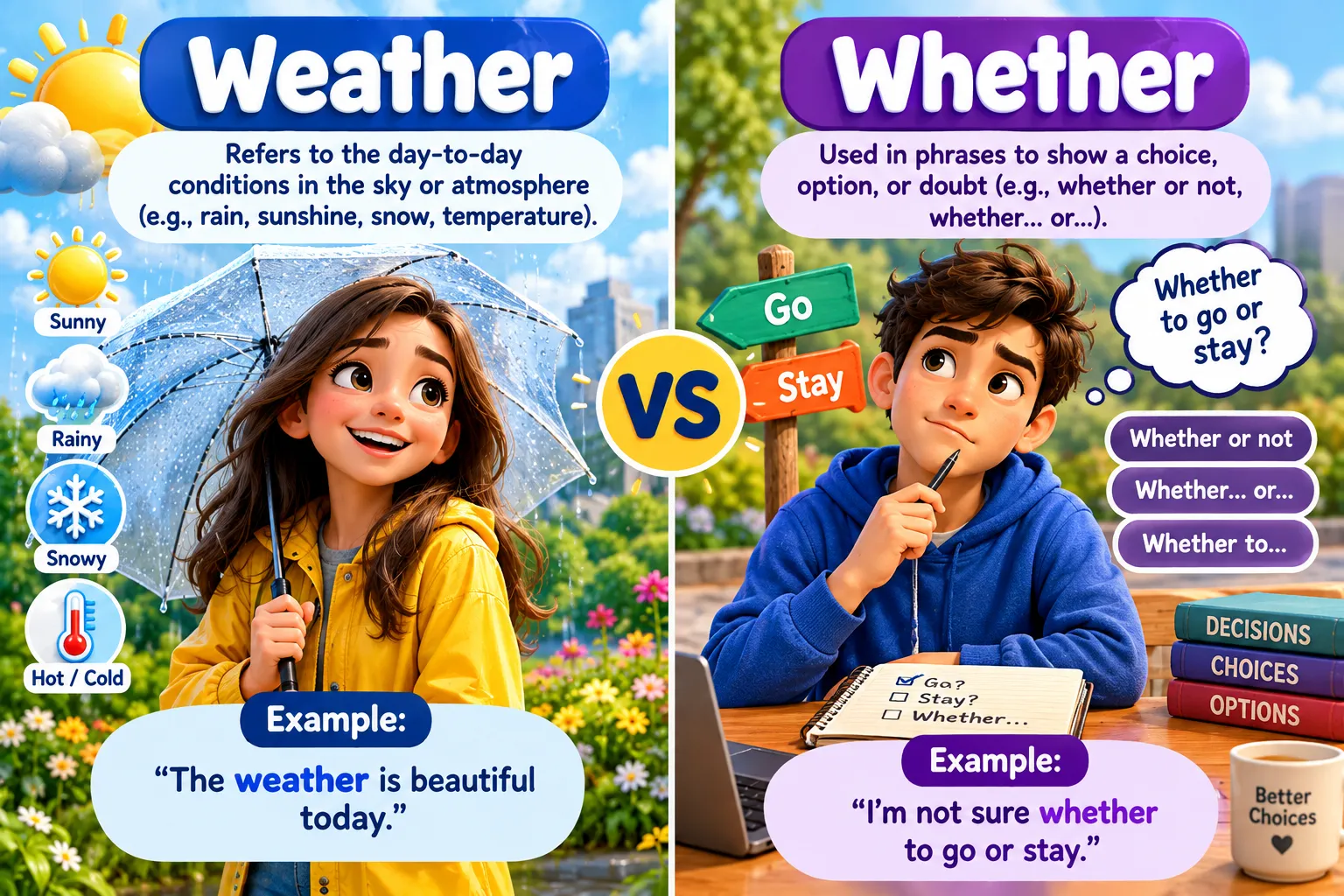
Weather refers to conditions outside, such as rain, wind, and sunshine. Whether is used to introduce a choice, doubt, or question, such as whether you should stay home or go out.
I have often seen people pause while writing because they are unsure whether to use weather or whether. The words sound almost the same, yet their meanings are very different. One describes the sky and the air around us. The other helps us talk about choices, doubts, and possibilities.
Imagine writing a message to a friend about your weekend plans. You want to ask if the rain will stop, but you type, “I don’t know the whether will improve.” The reader may understand what you mean, but the sentence contains a spelling mistake. The correct word is weather because you are talking about outdoor conditions.
I have found that the easiest way to avoid this error is to focus on what the sentence means. Are you talking about rain, sunshine, or wind? Use weather. Are you expressing uncertainty or presenting two options? Use whether.
In this guide, I will explain the meanings, origins, grammar rules, and common uses of both words. You will also find simple examples, comparison tables, and practical tips to help you choose the right word with confidence.
Weather or Whether Quick Answer
The words weather and whether are homophones. This means they sound alike but have different meanings and spellings.
- Weather is a noun that describes conditions in the air, such as rain, wind, heat, and snow. It can also be a verb meaning to survive a difficult time.
- Whether is a conjunction that introduces a choice, possibility, or doubt. It often appears with words such as or, not, and if.
Consider these examples:
- The weather looks perfect for a walk.
- I cannot decide whether to walk or take the bus.
A simple rule can help you remember the difference: weather describes conditions, while whether introduces possibilities.
The Origin and Background of Weather and Whether
Although these words sound alike, they have different histories. Their origins help explain why they are spelled differently today.
Where does the word weather come from?
According to the Online Etymology Dictionary , weather comes from the Old English word weder. It referred to the air, sky, or conditions around us.
Over time, the word developed into its modern meaning. Today, we use weather to describe rain, sunshine, storms, wind, and temperature.
The word also has a figurative meaning. To weather something means to get through a difficult experience.
For example:
- The small town managed to weather the economic crisis.
- These wooden chairs can weather years of outdoor use.
In both cases, the word suggests facing or enduring something.
Where does the word whether come from?
The word whether also has roots in Old English. traces it to Old English forms such as hwæther and hwether, which were linked to the idea of choosing between two possibilities.
Its meaning has changed over time, but the idea of alternatives remains important today.
For example:
- She asked whether the shop was still open.
- We must decide whether to accept the offer.
In these sentences, whether introduces a question or a choice. It does not describe the weather outside.
Why are weather and whether confused?
There are three main reasons:
- Similar pronunciation: Many English speakers pronounce both words in the same way.
- Similar spelling: Both words begin with w and end with -ther.
- Different grammar roles: One describes conditions or endurance, while the other connects ideas about choices and possibilities.
In linguistics, words that sound alike but have different meanings and spellings are called homophones. Other examples include right and write, pair and pear, and here and hear.
Weather or Whether Explained: Key Differences
The easiest way to choose the right word is to look at the meaning of your sentence.
1. When should you use weather?
Use weather when talking about the state of the atmosphere. It is usually a noun.
Common weather-related words include:
- Rain
- Sunshine
- Wind
- Snow
- Heat
- Storms
Examples:
- The weather report predicts strong winds tonight.
- Cold weather can make travel difficult.
- We enjoyed the warm weather during our holiday.
Weather can also work as a verb. In this case, it means to endure a difficult situation or to be affected by outdoor conditions.
Examples:
- The company weathered a difficult year.
- The old fence has weathered many storms.
2. When should you use whether?
Use whether when you are talking about a choice, a possibility, or something that is uncertain.
It is a conjunction, which means it connects a clause or idea to another part of a sentence.
Examples:
- I wonder whether he received my message.
- They have not decided whether to move abroad.
- Please tell me whether the information is correct.
You will often see whether with or when two options are presented.
For example:
– She cannot decide whether to study law or medicine.
Here, the two choices are clear. She must choose between studying law and studying medicine.
Comparison table
| Term | Meaning | When to Use | Region/Context |
| Weather | Conditions in the atmosphere | When discussing rain, wind, heat, or sunshine | All major varieties of English |
| Weather (verb) | To endure or survive something | When describing hardship or exposure to the elements | General and figurative use |
| Whether | A choice, doubt, or possibility | When presenting options or an indirect question | All major varieties of English |
| Whether or not | Regardless of the outcome, or a question about alternatives | When the result may be yes or no | Formal and informal writing |
Which Word Should You Use?
Your choice depends on what you want to say. You do not need to memorize a long list of grammar rules. Instead, ask yourself what the sentence means.
For students and English learners
Start by identifying the main idea.
- If the sentence describes rain, wind, or sunshine, use weather.
- If it asks about a choice or possibility, use whether.
- If the sentence means “survive a difficult time,” use weather as a verb.
For example, “I don’t know whether to call her” expresses uncertainty. The sentence is not about outdoor conditions, so whether is correct.
For professional emails
Check your word choice before sending a message. These errors can make an otherwise clear email look less polished.
Correct: “Please confirm whether the meeting will take place tomorrow.”
Incorrect: “Please confirm weather the meeting will take place tomorrow.”
The first sentence asks for confirmation. It needs whether.
For formal and academic writing
Both words are correct in formal English, but they serve different purposes.
Use weather when discussing climate, outdoor conditions, or the ability to withstand change. Use whether when discussing alternatives, uncertainty, or possible outcomes.
My best tip: Replace weather with “conditions outside.” If the sentence still makes sense, weather may be correct. If not, check whether whether expresses the meaning you need.
Common Mistakes with Weather and Whether
Even experienced writers can mix up these words. Here are five common errors and how to correct them.
Mistake 1: Using whether to describe the sky
Incorrect: We had beautiful whether during our trip.
Correct: We had beautiful weather during our trip.
Why? The sentence describes outdoor conditions, so weather is the right word.
Mistake 2: Using weather to introduce a choice
Incorrect: I cannot decide weather to buy the blue shirt.
Correct: I cannot decide whether to buy the blue shirt.
Why? The writer is unsure about a decision. The word whether introduces that choice.
Mistake 3: Confusing whether with if
In many sentences, whether and if can both express uncertainty.
For example:
- I wonder whether the train is late.
- I wonder if the train is late.
Both are acceptable in this context.
However, whether is often the clearer choice when you state two alternatives.
For example: “We need to decide whether to stay or leave.”
Mistake 4: Forgetting whether in indirect questions
Incorrect: She asked me weather I was ready.
Correct: She asked me whether I was ready.
Why? The sentence reports a question rather than asking it directly. Whether introduces the indirect question.
Mistake 5: Assuming weather is always a noun
Incorrect: The team whethered the difficult season.
Correct: The team weathered the difficult season.
Why? Weather can also be a verb meaning to endure or survive a challenge. In the past tense, it becomes weathered.
Weather or Whether in Real-World Examples
Seeing these words in everyday writing can make the difference easier to remember. Here are fresh examples from four common situations.
1. In a professional email
“Could you please confirm whether the office will remain open during the holiday?”
The word whether introduces a question about the office schedule.
2. In a news headline
“Severe Weather Expected Across the Region This Weekend”
Here, weather describes the expected outdoor conditions.
3. In a social media post
“Not sure whether to watch a movie or go out for dinner tonight!”
The writer is choosing between two activities, so whether is correct.
4. In a formal report
“The building materials were tested to determine whether they could withstand repeated exposure to moisture.”
The word whether introduces the possibility being tested.
5. In everyday conversation
“We will go hiking tomorrow, regardless of whether everyone feels ready.”
This sentence uses whether to show that the plan will continue no matter what the group decides or feels.
Weather or Whether: Data, Trends, and Usage
Understanding these words is useful for students, professionals, content writers, and anyone who wants to write clearly.
Which word appears more often?
Both words are common in English, but their frequency depends on the type of writing being studied. Weather appears often in forecasts, climate reports, travel content, and news about storms. Whether appears in many kinds of writing because it helps express questions, choices, and uncertainty.
The Google Books Ngram Viewers lets readers compare how often the two words appear in published books over time.
The chart measures word frequency in books, not monthly internet searches. It also does not tell us which word people misspell more often.
What about monthly search volume?
Exact monthly search volumes for “weather or whether” and related queries require current keyword data from tools such as Google Keyword Planner, Ahrefs, or Semrush. I cannot verify a reliable current number here, so I will not present an estimate as fact.
The likely search intent is informational: readers want to understand the meanings, spelling, and correct usage of the two words.
Why does the difference matter today?
Clear writing matters in school assignments, work emails, online articles, and social media posts. Spell-checking tools can help, but they may not catch this mistake because both words are spelled correctly on their own.
A tool may accept “I don’t know the weather he will attend” as a sequence of valid words without understanding that whether was intended.
That is why checking the meaning of a sentence remains an important grammar skill.
A Standalone Comparison: Weather, Whether, and Wether
There is one more word worth knowing: wether. It is a real English word, but it has a very different meaning.
| Term/Variant | Meaning | Region/Context | Best Used When |
| Weather | Atmospheric conditions; also, to endure something | General English | Discussing rain, sunshine, storms, or hardship |
| Whether | Introduces a possibility, choice, or indirect question | General English | Expressing doubt or comparing options |
| Whether or not | Indicates alternatives or that something applies regardless of the outcome | General and formal English | Discussing a decision or an outcome that will not change |
| Wether | A male sheep, usually castrated | Farming and animal husbandry | Writing about sheep or livestock |
Remember that wether is not a spelling variation of weather. It is a separate word with its own meaning.
Frequently Asked Questions
Q: What is the main difference between weather and whether?
A: Weather refers to atmospheric conditions or the act of enduring something. Whether introduces a choice, possibility, or indirect question. The correct word depends on the meaning of your sentence.
Q: How can I remember whether to use weather or whether?
A: Connect weather with the world outside: rain, wind, and sunshine. Think of whether when you are weighing options or asking yourself if something is true.
Q: Is it correct to say “I don’t know whether”?
A: Yes. You can use whether after phrases that express uncertainty, such as “I don’t know,” “I’m unsure,” and “I wonder.” For example, “I don’t know whether the shop is open.”
Q: Is weather or whether correct in formal writing?
A: Both are correct words in formal writing, but they cannot be freely swapped. Use weather for atmospheric conditions and whether for choices, possibilities, and indirect questions.
Q: Can whether be replaced with if?
A: Often, yes. For example, “I wonder whether she is home” and “I wonder if she is home” are both correct. However, whether is often preferred when the sentence clearly presents alternatives or uses the structure “whether … or.”
Q: Where do weather and whether come from?
A: Weather comes from Old English weder, a word for the air or sky. Whether comes from Old English forms such as hwæther, associated with choosing between possibilities. Their histories help explain their different meanings.
Q: Can weather be used as a verb?
A: Yes. Weather can mean to endure a challenge or withstand exposure to the elements. For example, “The family weathered a difficult period.” The past-tense form is weathered.
Q: Is “wether” the same as weather?
A: No. A wether is a male sheep that has usually been castrated. It is a less common word used mainly in farming and animal-related contexts.
Conclusion: Choose Weather or Whether with Confidence
The difference between weather and whether becomes simple once you focus on meaning rather than sound. Both words are correct, but they have separate jobs in a sentence.
Remember these key points:
- Use weather to describe rain, wind, sunshine, and other atmospheric conditions.
- Use weather as a verb when you mean to endure a challenge.
- Use whether to express doubt, introduce a choice, or report an indirect question.
- Remember wether as a separate word related to sheep.
When you are unsure, pause and read the full sentence. Ask whether you are describing the world outside or considering a possibility. That small check can prevent a common spelling mistake in essays, emails, reports, and everyday messages.
You do not need to memorize every grammar rule to use these words correctly. With a little practice, the right choice will become easier.
Bookmark this guide and share it with someone who wants to improve their English spelling and grammar.
Read More:
Allergies or COVID: Easy Guide to Spot the Difference

I specialize in English grammar, spelling, word choice, and language usage. My content is based on research from grammar references, style guides, dictionaries, and real-world usage to ensure it is accurate and practical.
At Spelling Comparison, I write guides that explain why words are confused, how they are used, and which form is correct in context. I also include proofreading tips, examples, and writing advice readers can apply immediately.
My goal is to publish clear, reliable content that helps readers make better writing decisions. Each guide is written for accuracy, clarity, and usefulness in school, work, business, and everyday communication.










