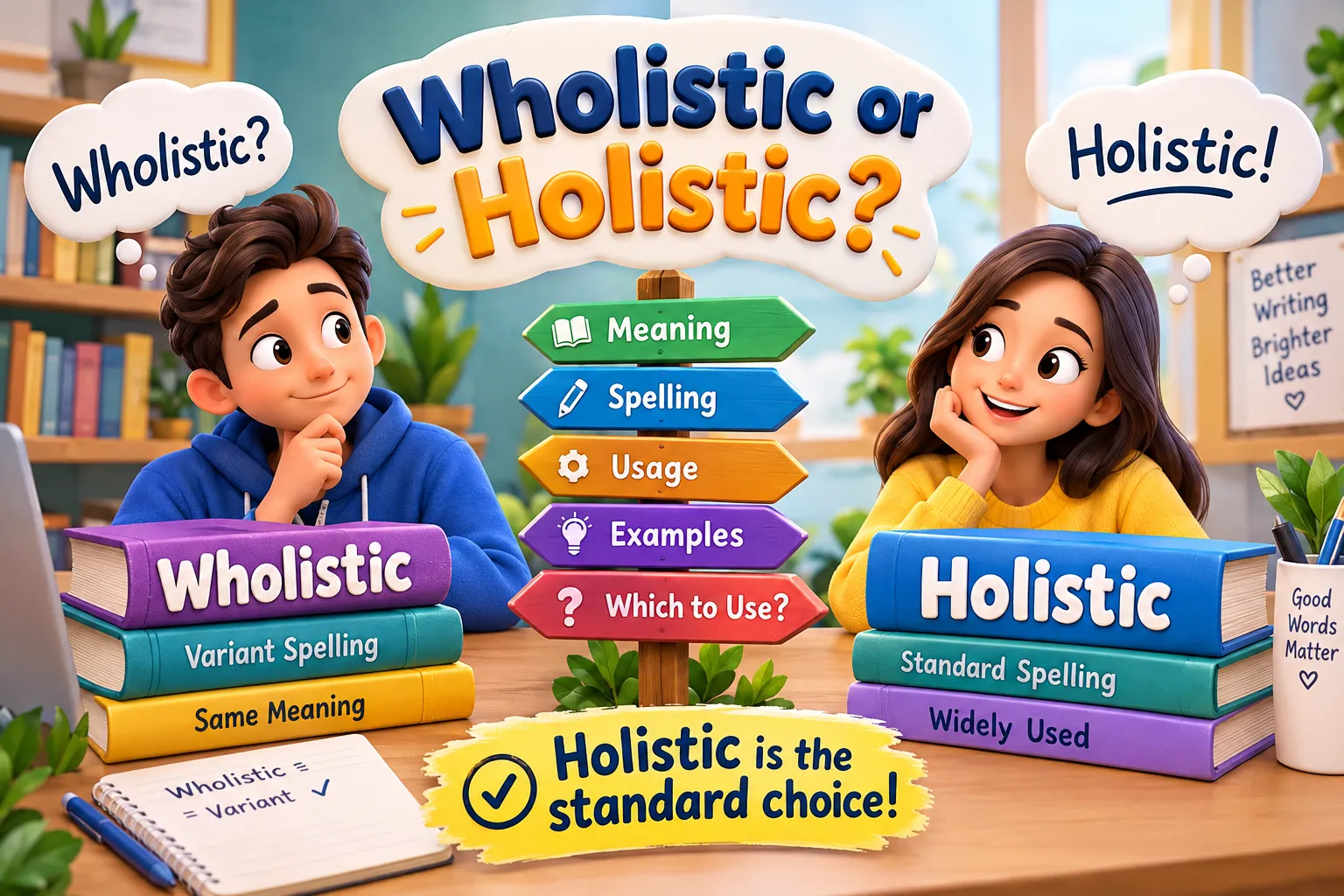
Wholistic or holistic both relate to considering something as a whole, but holistic is the standard and much more widely used spelling in modern English.
Have you ever typed a word, looked at it twice, and thought, “That spelling just does not look right”? I have had that moment many times while editing English lessons and professional copy. Wholistic is one of those words that can make even confident writers stop.
The reason is easy to understand. The word is linked to whole, so adding a “w” seems logical. Yet holistic is the form you will see most often in dictionaries, academic writing, health writing, and professional communication.
That creates a simple but useful question: Is wholistic wrong, or is it a real word?
The answer is more interesting than a simple yes or no. Wholistic is a recognized variant spelling, while holistic is the established standard form. Collins, for example, defines wholistic as a variant spelling of holistic.
In this guide, you will learn what both words mean, where they came from, how they differ in usage, and which spelling is safest for your own writing.
Wholistic or Holistic Quick Answer
Holistic is the spelling you should normally choose.
It describes an approach that considers the whole of something rather than only one part. Cambridge defines holistic as dealing with or treating the whole of something or someone instead of just a part
For example:
- The school takes a holistic approach to student development.
- The report gives a holistic view of the problem.
Wholistic has the same basic meaning and is recognized as a variant spelling. Collins lists it directly as a variant of holistic.
So, if you are writing an essay, email, report, website, or academic paper, holistic is usually the safer choice.
The Origin and Background of Wholistic and Holistic
The history of these two spellings explains why the confusion exists.
The word holistic is connected to holism, the idea of looking at something as a whole and considering how its parts relate to that whole.
According to Etymonline, holistic dates to 1926 and was formed from holism plus the adjective-forming ending -istic. Etymonline also traces holism to Greek holos, meaning “whole.”
The spelling wholistic came later. Etymonline dates it to 1941 and describes it as a form created by combining or crossing holistic with the English word whole.
That makes the spelling choice easier to understand.
Holistic comes through the history of holism.
Wholistic looks more directly connected to the familiar English word whole.
There is also an older history behind whole itself. Etymonline traces whole through Middle English hole to Old English hal, with meanings related to being entire, sound, healthy, or uninjured.
So the “w” in wholistic is not completely random. It reflects the spelling of whole. However, that does not make it the dominant modern form.
Wholistic vs. Holistic Key Differences
The biggest point is simple:
The two spellings generally refer to the same basic idea.
The difference is mainly one of standard usage, frequency, and context, rather than a major difference in meaning.
| Term | Meaning | When to Use | Region/Context |
| holistic | Considering the whole rather than isolated parts | General, academic, professional, and everyday writing | Broad international English |
| wholistic | Variant form of holistic | When a person, organization, or source specifically uses this spelling | Less common usage |
| holistically | In a way that considers the whole | Used when describing an action or approach | Standard modern English |
Cambridge gives examples of holistic in areas such as health, education, research, and problem-solving.
You might see phrases such as:
- holistic approach
- holistic health
- holistic education
- holistic care
- holistic development
- holistic view
- holistic solution
These phrases all focus on looking beyond one isolated part.
Why does “wholistic” look natural?
Because English already has whole.
A learner may naturally reason:
whole → wholistic
That looks logical.
But English does not always build words in the most obvious way. Word history matters. In this case, the established form developed from holism, not by simply adding a suffix to whole.
Which Version Should You Use?
For most writers, the practical choice is easy.
For students
Use holistic.
It is the form most readers will expect in essays, assignments, and formal educational writing.
Example:
The teacher used a holistic approach to assess the student’s progress.
For professionals
Choose holistic in reports, presentations, emails, and business documents unless you are following a particular organization’s spelling.
Example:
Our team needs a holistic view of the project’s risks.
For websites and general content
Holistic is the safer option for broad audiences because it is the established spelling used in major dictionaries.
For a specific name or organization
Keep the original spelling if Wholistic appears in an official name.
For example, an organization may deliberately use Wholistic as part of its brand identity. In that case, changing the spelling would change its proper name.
For neutral international English
Use holistic.
It is the clearest choice when you want your writing to look standard and familiar to a wide audience.
Common Mistakes with Wholistic or Holistic
Here are some mistakes that can easily slip into your writing.
| Mistake | Correction | Why |
| We need a wholistic approach. | We need a holistic approach. | Holistic is the standard general form. |
| The plan should be reviewed wholistically. | The plan should be reviewed holistically. | The standard adverb is holistically. |
| She has a holistical view. | She has a holistic view. | Holistic is already the adjective. |
| He thinks holisticly about the issue. | He thinks holistically about the issue. | The adverb uses -ically. |
| The project needs a holisticly solution. | The project needs a holistic solution. | The adjective is holistic, not holisticly. |
Mistake 1: Assuming “wholistic” is always wrong
That is too strong.
Wholistic is a recognized variant spelling. Collins lists it as a variant of holistic.
The better advice is to use holistic as your default.
Mistake 2: Writing “holistical”
The normal adjective is holistic.
You do not need to add another -al.
Mistake 3: Confusing “holistic” with “whole”
These words are related in meaning, but they do different jobs.
- whole = complete or entire
- holistic = considering something as a complete system or whole
For example:
I ate the whole apple.
But:
The doctor took a holistic view of the patient’s needs.
Wholistic or Holistic in Real World Examples
Seeing the word in different settings makes the difference easier to remember.
Professional Email
Our team should take a holistic approach before making changes to the training program.
Here, holistic means looking at the full situation rather than one small issue.
News Article
The new policy calls for a holistic strategy that considers education, housing, and employment.
The word works naturally because the strategy covers several connected areas.
Social Media Post
Real progress often comes from taking a holistic view of your goals, habits, and daily choices.
This is a common type of informal use.
Formal Report
The committee recommended a holistic assessment of the project’s long-term effects.
The word fits formal writing because it describes an assessment that considers multiple parts together.
Health Context
The term is also common in health-related language. The U.S. National Library of Medicine’s Medical Subject Headings (MeSH) uses Holistic Health as a preferred term and lists several wholistic expressions as entry terms.
This is a useful detail: wholistic is not simply invisible in formal terminology. It can appear as a recognized alternative, even when holistic is the preferred term.
Wholistic or Holistic Data, Trends & Usage
Exact monthly search-volume numbers for “holistic” vs. “wholistic” vary by country and SEO tool. Public tools also update their databases at different times.
For that reason, it would be misleading to invent a precise monthly search number here.
What the available evidence does show is more useful.
Dictionary evidence
Collins explicitly identifies wholistic as a variant spelling of holistic.
Cambridge provides a full dictionary entry for holistic and shows the word in contexts including health, education, research, and problem-solving.
Corpus evidence
Google Books Ngram Viewer can compare word frequency across large collections of books over time. Google explains that its Ngram tool displays how words and phrases occur in its book corpus and allows users to compare different English corpora.
The practical lesson is that holistic has a much stronger established presence in standard English than wholistic.
Health terminology
The difference becomes especially interesting in health language.
The National Library of Medicine’s MeSH system uses Holistic Health as its preferred descriptor while also recording Wholistic Health, Wholistic Medicine, and related forms as entry terms.
Why does this matter today?
People now write across many settings:
- workplace emails
- academic papers
- health content
- online courses
- business reports
- social media
- AI-assisted writing
That makes spelling choices more visible.
If you want a word that looks familiar and standard to the broadest group of readers, holistic is the safer default.
A Second Comparison Table: Which Form Fits Your Situation?
| Term/Variant | Meaning | Region/Context | Best Used When |
| holistic | Considering the whole system | General English | Almost all standard writing |
| wholistic | Variant of holistic | Less common English usage | Preserving a chosen or official spelling |
| holistically | Considering something as a whole | Standard English | Describing how an action is performed |
| holism | The concept of viewing things as wholes | Academic, philosophical, scientific | Discussing the underlying idea |
| whole-person | Focus on the complete person | Health and care contexts | Talking about care beyond one symptom |
This table also shows why holism and holistic are worth learning together. The noun names the broader concept, while the adjective describes something connected to that concept.
Related Words You May Also Confuse
If you are learning English, wholistic vs. holistic is part of a larger pattern.
English contains many words whose spelling does not match what seems most logical.
You may also encounter questions about:
- historic vs. historical
- economic vs. economical
- affect vs. effect
- complement vs. compliment
- practice vs. practise
- whole vs. hole
- all ready vs. already
These pairs are not all the same type of problem. Some involve spelling, some meaning, and some part of speech.
That is why checking the part of speech and dictionary meaning is often more useful than relying only on how a word looks.
FAQs About Wholistic or Holistic
Q: What does holistic mean?
A: Holistic means considering something as a whole instead of focusing on only one part. Cambridge defines it as dealing with or treating the whole of something or someone rather than just a part.
Q: Is wholistic a real word?
A: Yes. Wholistic is a recognized variant spelling of holistic. Collins lists it as a variant, although holistic is the standard form most writers will encounter.
Q: Is holistic or wholistic correct?
A: Holistic is the best default choice for standard English. Wholistic is also documented as a variant, so calling it simply “not a word” would be inaccurate.
Q: Is holistic acceptable in formal writing?
A: Yes. Holistic is widely used in formal, academic, professional, health, and educational contexts. Cambridge provides examples from several of these areas.Q: Where does the word holistic come from?
A: Etymonline dates holistic to 1926 and connects it with holism. The history of holism is linked to Greek holos, meaning “whole.”
Q: Why do people spell holistic as wholistic?
A: The spelling likely feels natural because it resembles the familiar word whole. Etymonline dates wholistic to 1941 and describes it as a form influenced by whole.
Q: Can I use wholistic in a professional document?
A: You can, especially if it is part of an official name or follows the spelling used by a specific organization. For ordinary professional writing, holistic is the clearer default.
Conclusion: Wholistic or Holistic?
The choice between wholistic or holistic looks confusing at first, but the rule is simple once you know the history.
Holistic is the standard spelling for general English. It means looking at something as a complete whole rather than examining only one part. Cambridge uses the word across areas such as health, education, research, and problem-solving.
Wholistic is not an imaginary word. It is a documented variant spelling. Collins specifically lists it as a variant of holistic.
The history also explains the unusual spelling. Holistic comes from holism, while wholistic appeared later and was influenced by the English word whole. (
So, when you are unsure, remember this:
Use “holistic” for normal writing. Use “wholistic” when a specific name, source, or style calls for it.
That small choice can make your writing look more polished and consistent.
Bookmark this guide so you never second-guess “wholistic or holistic” again.
Readmore

I’m an English language educator and SEO content writer having experience creating clear, accurate, and engaging English learning content. I specialize in spelling differences, grammar, vocabulary, synonyms, commonly confused words, and English usage. My goal is to publish well-researched, easy-to-understand articles that help students, writers, educators, and professionals improve their English with confidence through practical explanations and real-world examples.